A recruitment CRM built around AI Scout, which turns a role brief into a ranked shortlist that explains every candidate. Built by three co-founders and run in production with recruiting agencies.
At a glance
measured 23 Sep 2026 · customers onlyThe idea
Boutique technical recruitment agencies work across LinkedIn, spreadsheets, an applicant-tracking system and a notetaker. Two problems dominate: sourcing is slow and opaque, because AI tools that search better return a bare score a recruiter can't defend to a client, and what recruiters know about a candidate is scattered across the LinkedIn profile, the CV, GitHub and the interview notes.
Lope's bet was to bring every source into one candidate profile, then rank with evidence: each candidate's fit explained criterion by criterion (title, skills, experience, location, industry) in a form a recruiter can hand to a hiring manager. AI Scout does the ranking, and the rest of the product either feeds it candidates or acts on what it finds. This page follows the same order.
One profile, every source
how candidates get into LopeEnriched automatically from a URL, the Chrome extension or an AI Scout result, including current company and school. 3,246 profiles.
AI Scout's external and mixed searches import and enrich new profiles. 799 sourced by customers.
OCR plus structured extraction, one at a time or as a bulk ZIP upload.
Public repositories, languages and commit activity.
Calendar sync creates candidates from meetings (228), and the meeting bot adds transcripts, AI reports and team comments.
CSV import with field mapping, manual adds and custom fields.
AI Scout ranks on the structured profile built from LinkedIn data. CV, GitHub and interview evidence appears in the candidate sheet, the interview chat and candidate reports. Bringing that evidence into the ranking was the next planned step.
1 · AI Scout
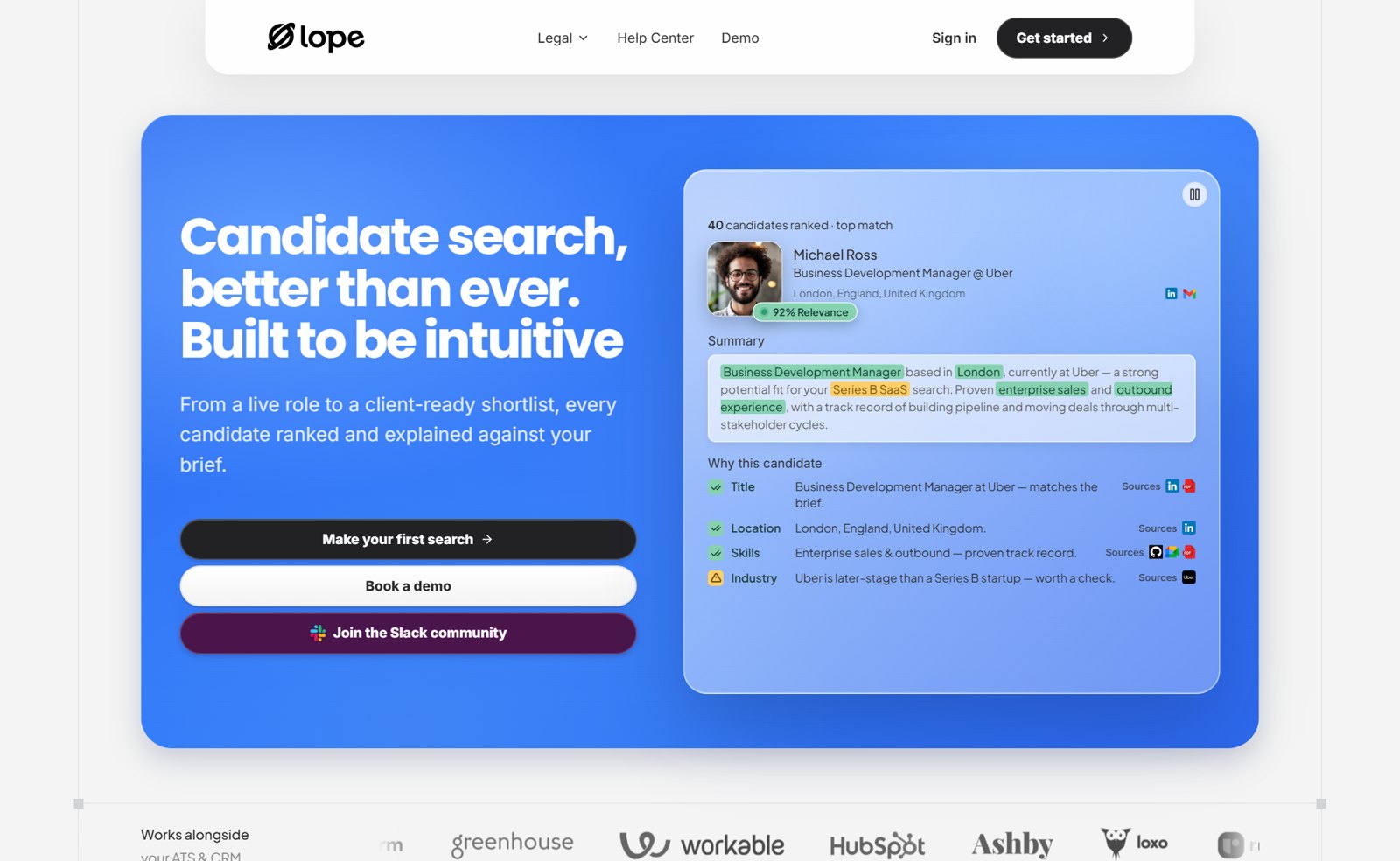
the core of the productA recruiter writes a brief such as “Senior backend engineer in Athens, 6+ years, Python and Kubernetes, fintech background.” AI Scout turns it into structured, editable criteria, searches, and returns a ranked list in which each candidate shows what matched and what's missing.
From a sentence to an explained shortlist
2:15The brief becomes criteria with synonym-expanded job titles, external sourcing imports new profiles and enriches their companies and schools as they arrive, and every result comes with a per-criterion explanation.
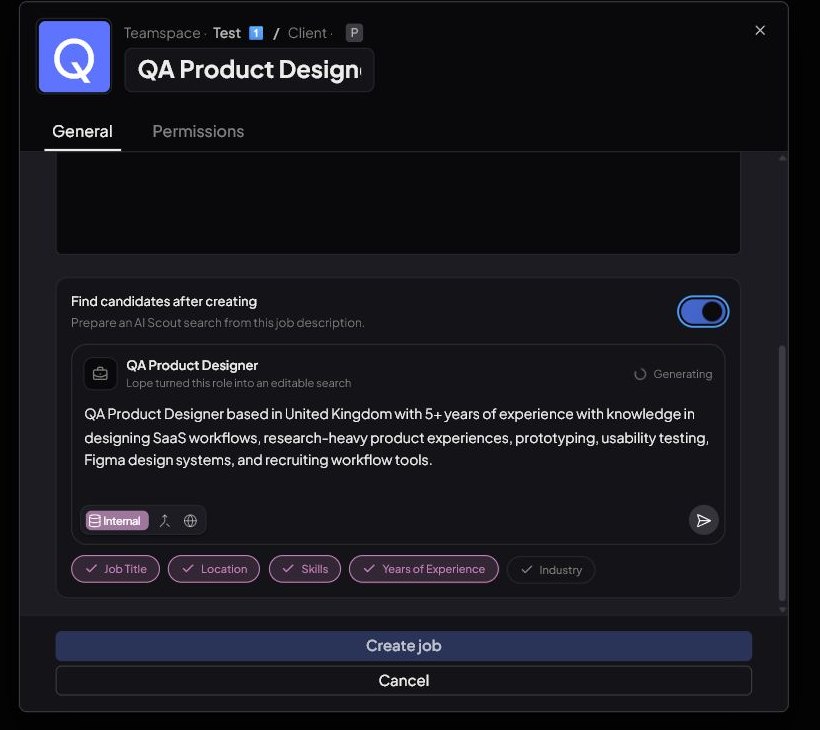
A prompt in plain language. The Search Agent, a conversational assistant that asks follow-up questions to sharpen the brief (beta). Search from a job, which turns a job description into a ready-to-run search.
Internal: the workspace's own candidates. External: a third-party talent database, with new profiles imported and enriched automatically. Mixed: both, ranked together.
A match breakdown per criterion and a relevance band on every result. Matched skills are highlighted with the evidence behind them, so the recruiter can defend the ranking.
Search Agent
1:49Asks the follow-up questions a senior recruiter would, then hands AI Scout a well-formed brief.
How the ranking works
Each criterion is scored on its own. Job titles are matched three ways (OpenAI embeddings, JobBERT, a model trained on job titles, and BM25 keywords), fused, then reranked by a cross-encoder. Skills, location, experience and industry each have their own index.
Eight Milvus collections feed five scored dimensions, merged by grouped Borda rank aggregation. Because every result keeps its per-dimension scores, each ranking can be explained.
The one known limit: on a single CPU-only VM the engine served concurrent searches one at a time, which was fine for pilot traffic. GPU inference was the planned next step.
2 · The recruiter workspace
ranked by importanceEverything around the search, ranked by importance. Each feature gets candidates into Lope, acts on what AI Scout finds, or, in the case of Lope MCP, brings the whole CRM into the AI assistants recruiters already use.
| Feature | What it does | Status |
|---|---|---|
| Interviews | Google and Microsoft calendar sync, a meeting bot for Meet and Teams, speaker-separated transcripts, editable AI reports from templates, and a chat whose citations are checked against the transcript. | ShippedMost-used by volume: 1,510 interviews synced |
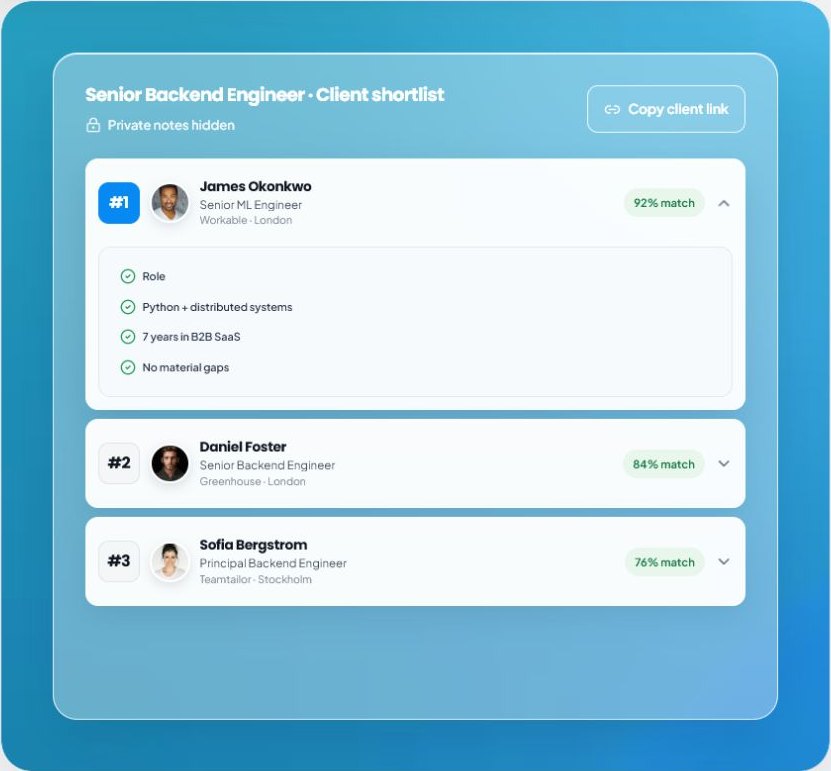
| Shortlists | Candidates evaluated and ranked against a versioned client brief, with a read-only client link that hides private notes. | Shipped701 AI evaluations at 99.0% success · 68 shared links |
| Lope MCP | A hosted Model Context Protocol server: add one URL in Claude, ChatGPT, Cursor or Gemini, sign in, and search candidates, run AI Scout, manage shortlists and read interviews from the assistant. 27 tools, OAuth 2.1 with scoped permissions. | ShippedWorks with Claude, ChatGPT, Cursor and Gemini |
| Candidate & company sheets | One profile per candidate combining LinkedIn, GitHub, CV and interview data, with an AI summary across all of them, next to a company sheet with firmographics. | ShippedLinkedIn enrichment 98.7% over ~3,000 profiles |
| Jobs | Client → Job hierarchy. A job description becomes an editable AI Scout search, with advanced weights. | Shipped |
| Chrome extension | A LinkedIn side panel that spots candidates already in your database and adds new ones, including bulk adds from Recruiter Lite. | ShippedPublished on the Chrome Web Store |
| Google & Microsoft accounts | Sign in with Google or Microsoft, then connect the work calendar that drives interview sync. | Shipped13 of 23 recruiters connected a calendar |
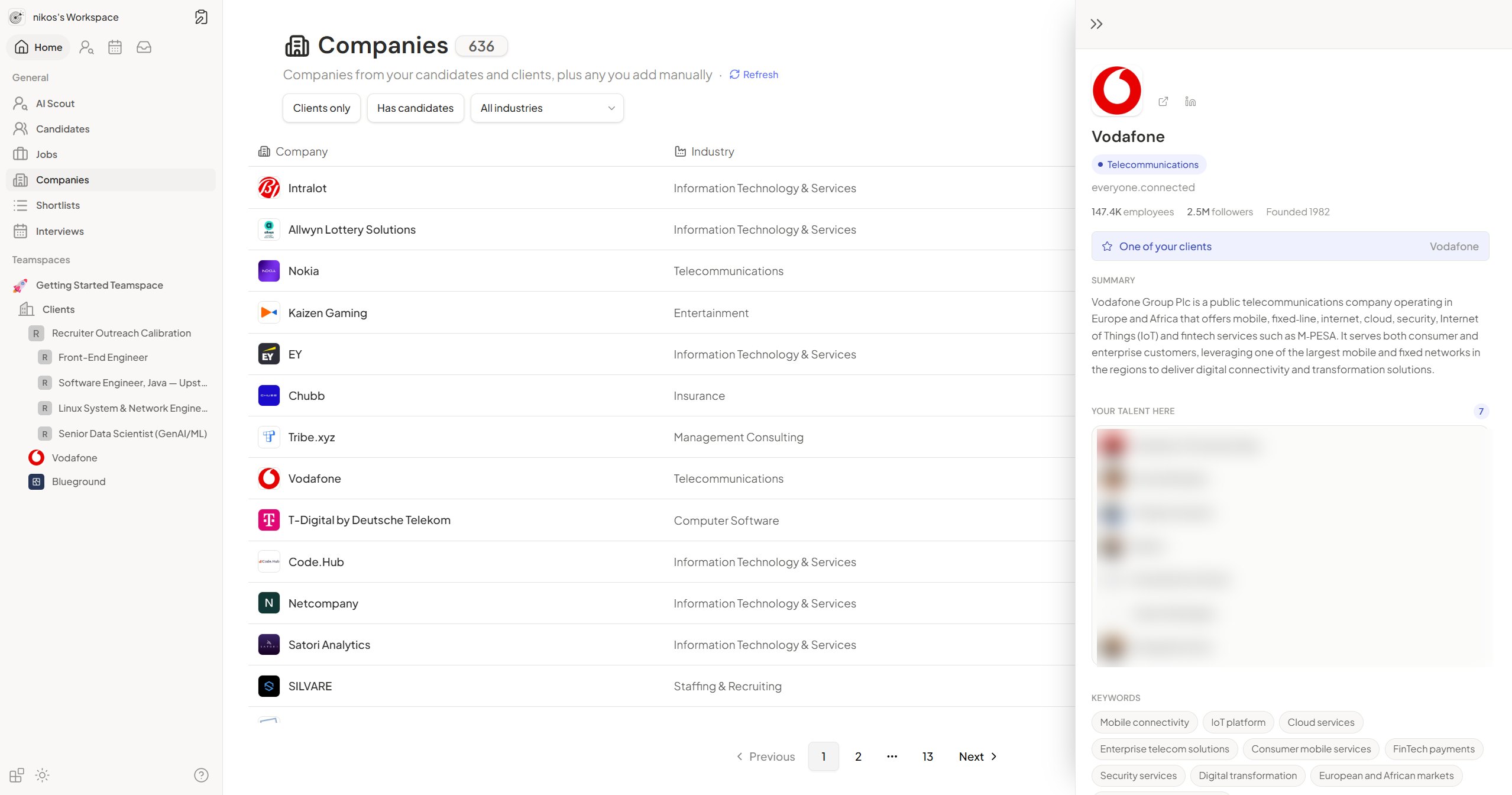
| Companies | “Recruit-from” pages: where your candidates work today, which companies are already clients, and firmographics. | Shipped lateJuly 2026; talent-flow panel never built |
| Collaboration | Interview comments with @mentions, an activity feed and external share links, on top of public/private access with roles enforced in the database. | PartialInterviews only; follow-up tasks and threaded comments not built |
Interviews
0:51Transcript, templated summary, and a chat that links each answer to the moment in the transcript.
Lope MCP inside Claude
0:43Sign in with scoped permissions, then ask Claude about candidates, pipelines and interviews.
Chrome extension
0:54Spots candidates already in your database and adds new ones, fully enriched, in one click.
3 · Smaller features
supporting the core| Feature | What it does | Status |
|---|---|---|
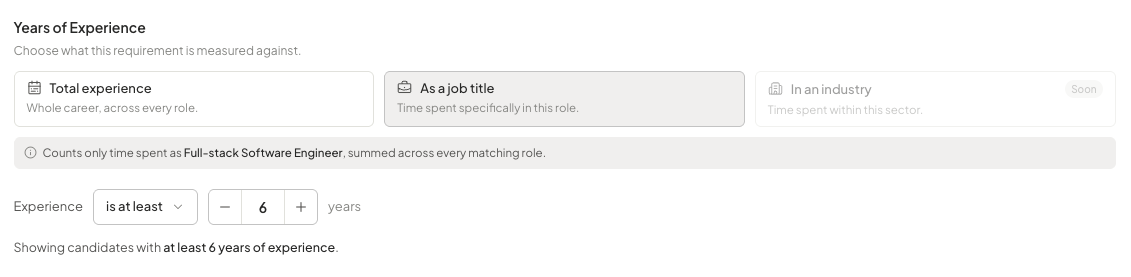
| Criteria & filter tuning | Suggested criteria, must-have vs optional skills, advanced weights, current/recent/full-career title matching, years of experience in a specific role, and industry inferred from a company name. | Shipped |
| Skill inference | Credits skills a profile shows in its own words and displays the quote behind each one. An LLM may only answer with a verbatim quote and a skill from a curated list. | ShippedFinal week, July 2026 · 1,345 candidates gained evidence · 0 unverifiable quotes in audit |
| CSV & CV import | CSV upload with field mapping; CV parsing with OCR and structured extraction, including bulk ZIP uploads. | Shipped |
| Salary estimation | A salary band per role and candidate, computed from market data, with an AI explanation that is not allowed to produce numbers. | PartialGreek market bands live; company-level adjustment unfinished |
| Candidate tracking | Watches LinkedIn for job changes, promotions, new skills and 5 other changes, with in-app and email notifications. | ShippedLightly used |
Also in the product: custom candidate fields, a 7-stage pipeline as a table and Kanban board, API keys, guided onboarding, and a help center with a public changelog.
Inferred by Lope AI
experience · Platform Engineer: “provisioned all three environments with Terraform modules”
about: “I automate infrastructure end to end”
Mid-range · 7 years as a backend engineer, in line with senior bands in Athens
Joined Northwind (previously at Contoso)
2 days agoPromoted to Staff Engineer at Contoso
3 months agoResults in production
Lope launched publicly in March 2026. Recruiters found it through LinkedIn, word of mouth, Slack and Discord communities, search, Reddit, a newsletter, a conference, and three through AI assistants (ChatGPT and Perplexity).
From July 2026 a Greek technical recruitment agency ran three recruiters on Lope as a design partner: about 950 of their interviews went through it, they ran 36 AI Scout searches and sourced ~450 candidates, and one recruiter used it across 75 days.
Most other sign-ups tried the product once. That concentration is part of why we paused.
How it was built
Explainable by construction
The ranking keeps a separate score for each criterion, so the explanation comes from the same numbers that produced the order.
Code decides; the model reads language
The Search Agent, the industry resolver and salary explanations work this way, and every model output is snapped back to a validated value. Salary figures are computed, never generated, and interview-chat citations are checked on the server before they render.
Multi-tenant all the way down
Row-level security on every table, with public/private visibility enforced from teamspace down to a single interview. The search engine ranks only the candidates the product sends it and never decides who may see what.
Production discipline
Long-running work runs as background jobs. Both Hetzner VMs ship immutable, commit-addressed releases with health checks and rollback, key-only SSH and closed database ports.
Three repositories (platform, search engine, help center) · 1,819 commits · ~350k lines of TypeScript and Python · 1,272 automated tests.
What we learned
Breadth is the trap for a small team
Interviews, pipeline and CRM each compete with a funded specialist. Our strategy review concluded we should cut back to explainable sourcing, the part that was hard to copy. This page is ordered the same way.
Defaults decide adoption
The meeting bot produced a transcript 77% of the time it was on, but recruiters turned it on for only 13% of interviews because auto-join defaulted to off.
Read usage from the database, not only analytics
Analytics alone said nobody reached the core workflow; the database showed active users running into coverage limits.
Pin LLM outputs that feed queries
A controlled experiment traced an apparent search bug to regenerated synonyms. Any model output that shapes a search is now cached per search.
My role
Nikos Mavrapidis · co-founderI worked across the whole platform (product, front end, back end, data, AI search, infrastructure and documentation) and was the most active contributor in both code repositories: 622 of 1,649 platform commits and 45 of 94 search-engine commits.
AI Scout and search quality
Skill matching that understands synonyms and composite skills, tested against a before/after evaluation harness; evidence-based skill inference; the vector-recall fix; the code-verified architecture of the ranking engine.
The recruiter workspace
Candidate grid and Kanban pipeline, candidate sheet, Companies, shortlist review and sharing, interview collaboration, CSV import and guided onboarding.
Access and data integrity
The row-level-security access model and roles, candidate de-duplication, migrations and calendar-sync consolidation.
Production operations
Releases with rollback on both VMs, server hardening, secret rotation, CI, a large share of the test suite, and the analytics guide that made the team measure usage from the database.
Built with
64 technologies and services · show
The full stack across the three repositories, plus the services Lope ran on. Every item here is used in the code or the production setup.
- Next.jsApp Router
- React
- TypeScript
- Tailwind CSS
- Radix UI
- shadcn/ui
- HeroUI
- TanStackQuery · Table
- Framer Motion
- React Hook Form
- Zod
- Lottie
- Tiptaprich text
- Zustandstate
- Node.js
- Fastifyproduct API
- SupabaseAuth · Realtime · Storage
- PostgreSQLRLS · pg_cron
- Denoedge functions
- Python
- FastAPIranking service
- Milvusvector search
- MinIO
- etcd
- OpenAIGPT-4o · 4.1 · embeddings
- Mistral AIOCR
- Hugging FaceJobBERT · cross-encoder
- PyTorch
- Model Context Protocolhosted MCP
- Gladiatranscription
- LangfuseLLM tracing
- Parallel AIcompany research
- LinkedInprofiles · companies
- Apifyscraping
- CoreSignaltalent data
- Skribbymeeting bot
- Google Calendarpush sync
- Google Meet
- Microsoft Teams
- Microsoft GraphOutlook calendar
- GitHubprofile enrichment
- Chrome Web Storeextension
- levels.fyisalary bands
- GeoNameslocations
- Netlifyweb app
- Hetzner2 VMs
- Cloudflaretunnel
- Docker
- Linuxsystemd
- GitHub ActionsCI
- Bunny CDN
- PostHogproduct analytics
- Resendemail
- Intercomsupport
- Slackcustomer community
- Mintlifyhelp center
- Vitest1,272 tests
- Playwrighte2e
- ESLint
- Nxmonorepo
- Git
- Claude Code
- Codex
- Cursor